
Ulysses Jenkins, visionary video artist and cultural storyteller, dies at 79

A visionary educator and early innovator in video art, Jenkins shaped generations of artists and expanded the language of media and performance.
Ulysses Jenkins, a trailblazing video, performance and multimedia artist whose work helped define the language of contemporary media art while fiercely critiquing race and representation in American culture, died on Feb. 23, 2026, at age 79. Jenkins’s influence extended internationally through exhibitions, retrospectives and decades of mentorship as a beloved educator at the University of California, Irvine.
Born in Los Angeles in 1946, Jenkins discovered art in the vibrant cultural landscape of Southern California. After graduating from Southern University in Baton Rouge in 1969 with a Bachelor of Arts in painting and drawing, he returned to Los Angeles, where he worked as a community art instructor and began exhibiting his paintings. His early work as a muralist included contributions to Judy Baca’s Great Wall of Los Angeles, a half-mile mural chronicling the diverse histories of California.
In the early 1970s, Jenkins co-founded Video Venice News, a media collective that used newly accessible portable video technology to document everyday life and community moments often overlooked by mainstream media. His Remnants of the Watts Festival (1972–73), later compiled in 1980, remains a seminal document of community resilience following the 1965 Watts Uprising.
Jenkins formalized his study of video and performance at the Otis Art Institute, earning an M.F.A. in 1979. While at Otis, he studied under influential artists including Charles White and Betye Saar. During that period, he also became part of a broader Los Angeles circle of experimental artists, including David Hammons, Kerry James Marshall, Maren Hassinger and Senga Nengudi, whose collaborative energy helped shape the city’s avant-garde art scene. This community of collaborators — sometimes called Studio Z — helped shape the radical, experimental art scene in Los Angeles in the late 1970s and early 1980s.
From that moment forward, Jenkins’s work fused storytelling, music, ritual, poetry and performance into what he described as a practice of the video griot — a modern iteration of the West African storyteller who preserves collective memory and identity. His breakthrough piece Mass of Images (1978), considered one of the first experimental video works by a Black American artist, featured Jenkins confronting a stack of televisions playing racist imagery, in a powerful metaphor for the way mass media shapes perception and reinforces stereotypes.
Over the next five decades, Jenkins’s art spanned documentary, satire, history, ritual and multimedia exploration. Among his noted works were Two-Zone Transfer (1979), which combined performance and satire to examine Black identity; King David (1978–79), featuring fellow artist David Hammons; Inconsequential Doggereal (1981); Dream City (1983); and Without Your Interpretation (1984), the title piece of his career retrospective. In recent years he collaborated on Ethnic Cleansing (2022), a music video responding to global conflict with his band Othervisions.
Jenkins’s work was exhibited at major institutions including the Whitney Museum of American Art, the Getty Center, The Studio Museum in Harlem and the Fondation Cartier pour l’art contemporain in Paris. In 2008 his work was shown in California Video, and in 2011 he participated in Now Dig This! Art and Black Los Angeles, 1960–1980. His pieces were included in the 2025 Photography and the Black Arts Movement, 1955–1985 at the National Gallery of Art.
In 2021, the Institute of Contemporary Art in Philadelphia opened Ulysses Jenkins: Without Your Interpretation, the first major museum retrospective of his work. Co-organized with ICA Philadelphia, the exhibition traveled to the Hammer Museum in Los Angeles in 2022 and to the Julia Stoschek Foundation in Berlin in 2023. Curated by Erin Christovale and Meg Onli, it traced more than five decades of Jenkins’ art, highlighting his fusion of video, performance and cultural critique.

Image: (left) The cover of Ulysses Jenkins: Without Your Interpretation, edited by Erin Christovale and Meg Onli, with contributions by Ulysses Jenkins and a foreword by Anne Philbin. (right) Jenkins signing a copy of the catalogue for a museum visitor at the Hammer Museum in 2022.
Beyond his art, Jenkins was an influential teacher. After early posts at California State University, Dominguez Hills, Otis College of Art and Design and UC San Diego, he joined the faculty of University of California, Irvine in 1993 as Professor of Art with an affiliate appointment in African American Studies. He taught for nearly three decades before retiring as Professor Emeritus in 2022, inspiring multiple generations of artists to rethink technology, narrative and cultural authority.
Jenkins’s honors included three individual artist fellowships from the National Endowment for the Arts, awards from the California Arts Council and first-place recognition in experimental video from the Black Filmmakers Hall of Fame. His work is held in major museum collections, including the Whitney Museum of American Art, the Museum of Contemporary Art, Los Angeles, the Hammer Museum and the Julia Stoschek Foundation in Berlin.
Colleagues remember Jenkins as both a wise storyteller and a fierce critic of visual culture. His art confronted the politics of image and media at moments when the power of broadcast and digital technologies was expanding rapidly, and his legacy stands as a powerful testament to the role of art in rethinking history and identity. Through decades of teaching and mentorship at UC Irvine, he transformed the lives of students and helped shape the future of media art for generations to come.

Image: Ulysses Jenkins at his retirement celebration in 2022 at the Claire Trevor School of the Arts, surrounded by fellow faculty from the Department of Art and across campus. From left to right: Bryan Jackson, Bridget R. Cooks, Deborah Oliver, David Trend, Jesse Colin Jackson, Antoinette LaFarge, unidentified guest, Ulysses Jenkins (seated), Miles Coolidge (center), Jennifer Pastor, Monica Majoli, Daniel Joseph Martinez (kneeling), Amanda Ross-Ho, Liz Glynn, Bruce Yonemoto and Juli Carson.
Additional Tributes:
ARTnews: https://www.artnews.com/art-news/news/ulysses-jenkins-dead-video-artists-1234774799/
Otis College of Art and Design (formerly Otis Art Institute): https://www.otis.edu/about/otis-now/news/otis-college-alum-ulysses-jenkins-has-died.html
Learn more about Ulysses Jenkins in his own words:
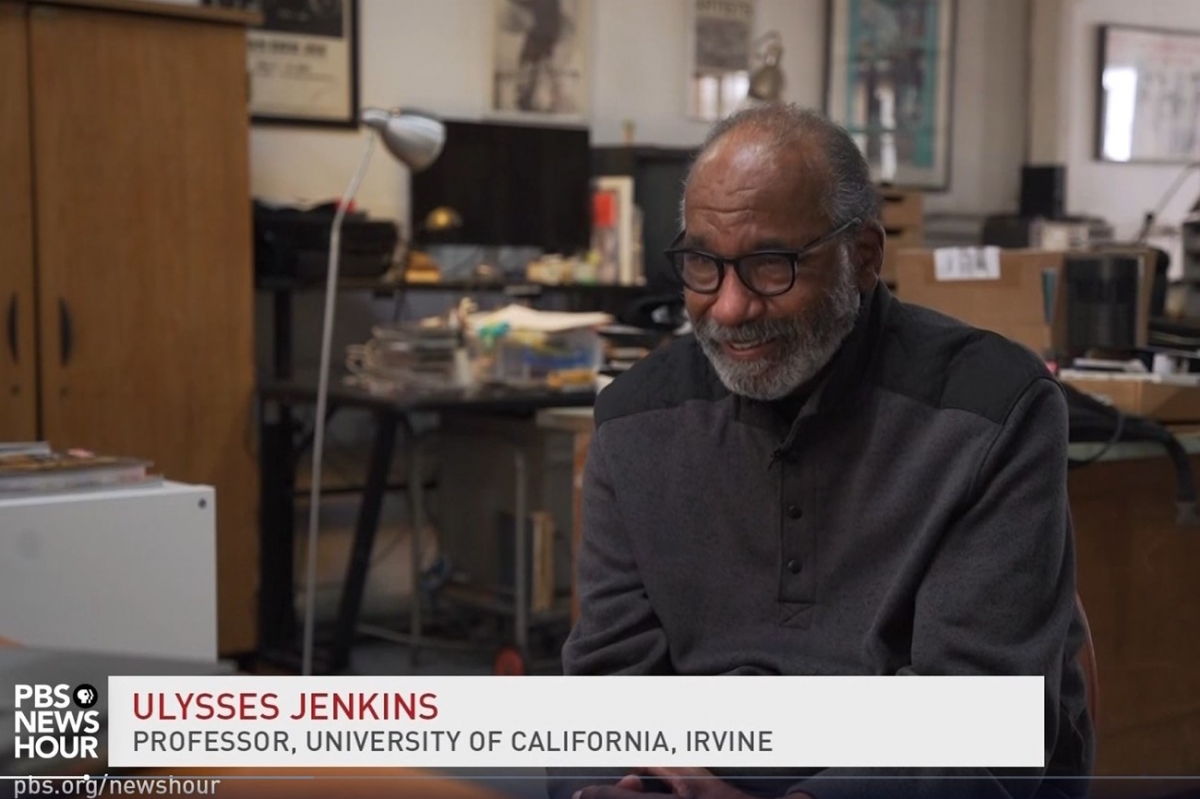
March 18, 2022 - PBS Newshour (CANVAS Arts, Video)
Ulysses Jenkins was considered a pioneer in the world of video art, which emerged as artists in the 1960s and '70s began using lighter and more affordable video cameras to create work and tell stories. One of the first Black artists in the field, Jenkins focused on stereotypes he saw in the media and popular culture, the -- quote -- "Mass of Images," as he titled a 1978 video